


If you let your holiday property through several platforms such as Airbnb, Booking.com, Vrbo and others, sooner or later you will face the same challenge: keeping bookings synchronised.
Because every price, rule or availability change you make by hand doubles or triples the problem, and the risk of a double booking increases.
How do you solve this problem? With a channel manager.
That is why we have prepared this short guide so you can understand what a channel manager is and how it can help you:
- Save time managing bookings
- Avoid overbookings and cancellations
- Offer your guests the best possible experience…
Because that is the point: your guests should enjoy their stay and your income should be stable.
And do not worry. Although it may sound a little technical, you only need to understand three or four concepts.
Let us look at them now…As simple as that.
What Is a Channel Manager?
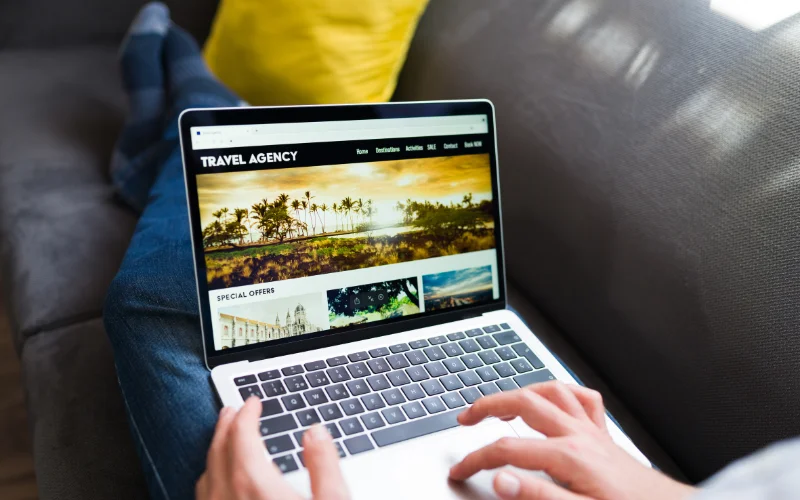
Let us start at the beginning: a channel manager is software that connects your listings on Airbnb, Booking.com, Vrbo and other platforms so you can synchronise availability, prices and bookings from a single dashboard.
As simple as that.
So, when a booking comes in through one channel, the system automatically blocks those dates on the others. And when you update a rate or condition, the change is replicated immediately.
In other words, it is one control panel that coordinates all your listings at once.
What do you gain from this?
Fewer human errors and greater agility.
For example:
- If you release a last-minute gap today, the change appears on every platform within seconds.
- If you have your own website with a booking engine, the channel manager can integrate it so your direct bookings do not overlap with the others.
As you can see, it is all upside: it removes repetitive tasks, lets you control everything from one place and, in some cases, can even be managed directly from your mobile phone.
But the benefits do not stop there. They go much further…
Benefits of Using a Channel Manager
Automating Listing Management
Updating something once and seeing it reflected everywhere is a huge relief, that much is clear.
But you can also apply global rules without repeating the same work: minimum stays, date closures, check-in and check-out policies or specific supplements.
For example, if you raise August rates by 10 per cent from the channel manager, the system applies the change directly to Airbnb, Booking.com and Vrbo.
Can you imagine how much time that saves?
And the peace of mind that comes from knowing everything is synchronised?
Real-Time Price and Availability Synchronisation
Not all channel managers work in exactly the same way.
Ideally, they should use an API, meaning a direct connection between systems. Put another way: the channel manager should talk to Airbnb, Booking.com and Vrbo in real time and update them at the same time.
Be careful with automations that use iCal-style calendars, because they can have synchronisation delays.
What we want is for date blocks and price changes to appear immediately, reducing errors as much as possible.
So when choosing a channel manager, pay close attention to whether it communicates via API.
Reducing the Risk of Overbooking
This is the most important feature of all and the one that justifies investing in a channel manager: avoiding overbookings.
How does it work?
The concept is simple: the system creates a unified calendar that blocks dates on every platform when a booking is confirmed.
The key is that it happens in real time, as we mentioned earlier. In fact, many channel managers even keep a change log so you can review what happened if something does not add up.
So with this in place, there are no excuses: overbooking does not need to be a daily concern for holiday property owners.
How It Can Help Holiday Property Owners

Saving Time and Effort
Logging into three extranets every time there is a booking or a change is exhausting. With a channel manager, everything becomes more efficient because you can:
- Centralise tasks
- Use seasonal templates
- Edit prices or availability in bulk…
As a result, you spend less time on admin and more on the guest experience, or on enjoying your free time, which matters too.
Improving Listing Visibility and Positioning
What is the number one concern for holiday property owners?
Keeping their property booked all year round.
If you want to increase the chances of that happening, you need to increase the number of channels where your property, or properties, are listed.
Why? Because the more visibility you have, the more booking opportunities you generate.
But being on several channels is only practical if you have a channel manager. The term itself says it: channel manager = manager of channels.
And it is not just about saving time or synchronising calendars. Consistent, up-to-date listings also tend to rank better on platforms, which translates into more enquiries and bookings.
On top of that, using a channel manager lets you test new portals without increasing your workload and reach new audiences who would otherwise never find you.
Example:
- Airbnb: 100 million users/month
- Booking.com: 100 million users/month
- Vrbo: 18 million users/month
You get the idea. Everything becomes more scalable.
Optimising Income and Occupancy
So far, we have talked about synchronising prices and calendars. But what happens if you want to apply differences by channel? Once again, a channel manager is the better option.
Why would you want to differentiate by channel? You may be wondering.
Let us look at a few examples:
- If one channel is more focused on long family stays, such as Vrbo, you may want to adjust prices to that specific demand.
- You may want to test raising prices overall to see whether results improve, but prefer not to take risks and start with just one channel.
A channel manager is also extremely useful when you need to react quickly to an unexpected event or certain demand peaks.
So if there is suddenly a concert in your area, a few loose nights remain unsold or your property starts receiving a lot of interest, you can raise prices quickly.
In short: you improve occupancy, change prices in a synchronised way or by channel, and adapt to supply and demand so you do not miss opportunities.
How to Choose the Best Channel Manager: Factors to Consider
Choosing well is half the battle.
That is why we recommend using this checklist when choosing one:
- True synchronisation: look for API connections with Airbnb, Booking.com and Vrbo. Also ask about latency, meaning how long a change takes to appear.
- Ease of use and mobile app: look for a clear interface, simple onboarding and an app that lets you manage the basics from your phone.
- Integrations: make sure it connects with your priority channels and, if you use a PMS, that there is an integration. Also consider whether it integrates with dynamic pricing tools or smart locks so you can keep the number of tools you use to a minimum.
- Bulk editing and rules: check that you can change seasonal prices, minimum stays and date closures, differentiate prices by channel and apply reusable templates. Also check whether rules can be copied quickly between properties if you manage several; it will save you a lot of time.
- Support and service hours: when something fails, you will want a quick response. Ask about typical response times, contact channels and the quality of the support team.
- Reliability and robustness: prioritise providers that offer change logs and history. It is also important that their servers are stable and do not go down easily.
- Price and charging model: calculate the monthly cost according to your volume and avoid long commitments at the start. That said, also consider the return in time saved and in all the errors you avoid, which is already a lot.
- Scalability: if you plan to add more properties or channels, make sure it is easy and the costs are clear. Also check that you can upgrade your plan without too much friction.
Do You Need a Channel Manager to Manage Your Holiday Let?
This information may feel a little overwhelming, and you may not want to spend all your time choosing a channel manager, working out which is best, learning how to use it and applying the right strategy.
After all, you probably let your holiday property because you want stable income that is also passive.
In that case, if you would rather delegate the management of your property, at Home2Book we are a holiday let management company and manage more than 600 properties under this model.
This is what we offer:
- We have professionals specialising in customer service, revenue management and marketing to help keep your property booked.
- We take care of cleaning, key handover and repairs so you do not have to worry about anything.
- We also provide an app with a unified calendar and bookings thanks to the use of a channel manager, so you can increase your visibility and block dates whenever you want.
Contact us through this form and we will be happy to help with anything you need.