


If you manage a holiday home, house rules are essential because they create a framework for coexistence, help avoid problems with neighbours and reduce negative reviews.
The issue is that owners often put them in a few lines in the listing, but once guests arrive at the property, they forget them and do not have them visible during the stay.
That is why we have prepared this guide with everything good house rules for a holiday let should include:
- What to include
- How to communicate it
- And what to do when someone does not respect the rules.
At the end of the article, you will also find a free template that you can copy and adapt to your property in ten minutes if you wish.
General rules
General rules are the basic block: what applies to any property, whether it is a flat, apartment, villa or rural house.
You should cover at least these points:
→ Respect for neighbours and the surroundings. This is rule number one. Guests need to understand that they are staying in a residential property, not an isolated hotel. Noise, slamming doors and loud music all affect coexistence.
→ No parties or events without authorisation. Put it in writing. It is not enough to suggest it: it must be clear that parties in the property are not allowed unless expressly authorised by the owner or manager.
→ Maximum number of guests. State how many people can stay, meaning those included in the booking, and whether visitors are allowed. This is not just about comfort: most regulations set a legal maximum capacity.
→ Identification on arrival. In Spain, traveller registration rules require guest identity data to be collected at the start of the stay. It is a legal obligation and should be explained naturally.
Timings
Timings are one of the rules that prevent the most conflict when they are properly communicated. Make sure you include them in your house rules:
→ Check-in and check-out. Clearly define arrival and departure times. A typical check-in is from 15:00-16:00 and check-out before 10:00-11:00, but it depends on how you want to organise things. If you charge for early check-in or late check-out, state it in advance.
→ Quiet hours. The standard is usually 22:00 to 8:00, although some owners’ communities have their own internal rules. The best approach is to follow the most restrictive timetable and make it clear. Use friendly wording such as “Please respect quiet hours from 22:00 to 8:00”.
→ Facility opening times. If the property has a pool, communal terrace or barbecue area, include the permitted hours of use. In many buildings these times are set by the community, not by the owner.
Use of facilities
Our recommendation here is not to assume guests know how everything works. Be explicit, but keep it brief and concise:
→ Kitchen and appliances. Mention any appliance with special instructions, such as an induction hob, oven or dishwasher. Believe us, a laminated sheet with basic instructions next to the appliance can prevent more than one incident.
→ Bathrooms and communal areas. If something must not be flushed down the toilet, or if the hot water system has any particular feature, mention it. It may seem minor, but plumbing issues caused by misuse are more common than they look.
→ Restricted areas. If there is a storeroom, room or cupboard reserved for the owner’s use, state it in the rules and mark it physically in the property, with a discreet sign or lock.
→ Heating and air conditioning. Ask for responsible use of air conditioning and heating. Many owners include a recommended temperature, for example “please keep the thermostat between 20°C and 24°C”, and ask guests to close windows when the system is on.
Cleaning and maintenance
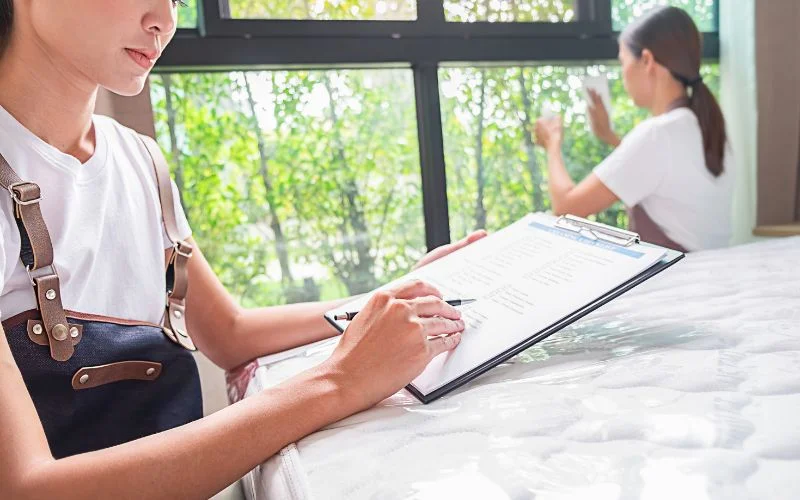
→ What the host covers and what is expected of the guest. Make it clear that the property is delivered clean and is expected to be returned in reasonable condition. The guest does not need to clean, but should collect their belongings, leave the kitchen tidy and avoid excessive dirt.
→ Waste and recycling. Indicate where the bins are, what goes in each one and how often rubbish should be taken out. In many holiday homes, recycling is the weak point. A small sign helps a lot.
→ Immediate damage reporting. Ask guests to report any damage or fault as soon as they notice it. It is better to know straight away than to discover it after they have left, so include the contact number clearly.
Safety
→ Close doors and windows when leaving. It sounds obvious, but it is one of the most common causes of incidents in holiday homes. Emphasise it especially if the property is on the ground floor or has direct outdoor access.
→ Safety devices. State where the fire extinguisher and emergency exits are. If the property has an alarm, explain simply how it works.
→ Keys and access. Explain the access system, whether key, lockbox or electronic lock, and what to do if keys are lost. If there is a charge for lost keys, you can mention it here too.
→ Emergency numbers. Always include: 112 for general emergencies, the owner or manager’s number and, where applicable, the security company or property management company’s number.
Pet policy

This point needs to be very clearly defined, because it is a sensitive area where confusion creates problems.
→ If pets are allowed: state the conditions, such as maximum size, number, areas where they are allowed, obligation to pick up waste and any cleaning supplement. Make it clear that the pet owner is responsible for any damage.
→ If pets are not allowed: say so clearly and directly. “Pets are not allowed in the property” is enough. Add that unauthorised animals may lead to a penalty or cancellation of the stay.
Important: if someone travels with an assistance dog, the situation changes. Check the applicable regulations in your autonomous community, because restrictions on assistance animals are tightly regulated.
No-smoking policy
→ No smoking inside the property. This is almost universal in holiday letting. State clearly that smoking and vaping are not allowed inside. If there is an outdoor area where smoking is permitted, such as a terrace or garden, specify it.
→ Extra cleaning cost. Many owners include an extra cleaning clause if smoking is detected inside the property. That is legitimate, but make sure you state the amount in advance to avoid disputes.
Consequences for non-compliance
Nobody wants to reach this point, but rules need defined consequences if they are to be effective.
→ Possible sanctions. Explain what may happen if a guest breaches the rules, from an additional charge for extra cleaning to partial retention of the deposit or, in serious cases, cancellation of the stay.
→ Damage procedure. Explain how damage will be documented, with photos and a written report, who will assess it and how payment will be managed. The more transparent the process, the fewer conflicts you will have.
→ Escalation. If the breach is serious, such as an unauthorised party or dangerous behaviour, the owner or manager reserves the right to ask the guest to leave the property. Including this option in the rules does not mean you will use it often, but it gives you a framework for serious cases.
Contact and emergencies
→ Owner or manager contact details. Name, phone number and email address. State when you are available and what to do outside those hours. If you delegate management to a company, the contact details should be theirs.
→ Emergency procedure. Beyond phone numbers, it is worth including basic instructions: where the water stopcock is, how to cut the electricity from the main board and what to do if the alarm goes off.
Thank you
House rules are not threats. As we said at the beginning, they are simply a framework for coexistence. That is why it is best to close the document with a thank you, leaving a good impression, because 99% of guests do want to do things properly.
We suggest ending with something like this:
“Thank you for respecting these rules. They are designed to make your stay comfortable and to maintain good coexistence with the neighbours. If you need help, please contact us. We hope you enjoy your stay.”
This type of closing is not only more human: it also encourages guests to follow the rules and, incidentally, to leave you a good review.
Would you like to download a template?
You can use our free template as a starting point and adapt it to your property’s particular features in just a few minutes.
Simply fill in this form and you will be able to download it.
And if you would rather we take care of everything for you, Home2Book is a holiday rental management company and we manage more than 600 properties in Spain.
We handle the rules, guest communication, incidents and everything involved in the day-to-day running of a holiday let.