


When you own a holiday let, every booking you receive is good news.
“The house will be booked next week!” you happily exclaim as soon as the email arrives.
But everything changes when you receive the payout from the platform, whether Airbnb, Booking.com or another OTA, and they have charged you a percentage as a commission you had not factored in.
Then you ask yourself: hang on, how much commission does Airbnb charge?
And your inner conversation does not stop there. Other questions start to appear too:
- Am I setting my prices properly?
- Could I have raised them?
- Should I have set a minimum number of nights?
Because, let’s admit it, information about Booking.com and Airbnb fees is not easy to find and, above all, not easy to interpret.
But do not worry: we have prepared an article with all the details so you can quickly check, without getting lost, what Booking.com and Airbnb fees are and know with confidence:
- What net amount you can expect when you are paid
- How to set prices with proper criteria
- And how to protect your property’s profitability.
So, without further ado, here is all the information…
Booking.com commission
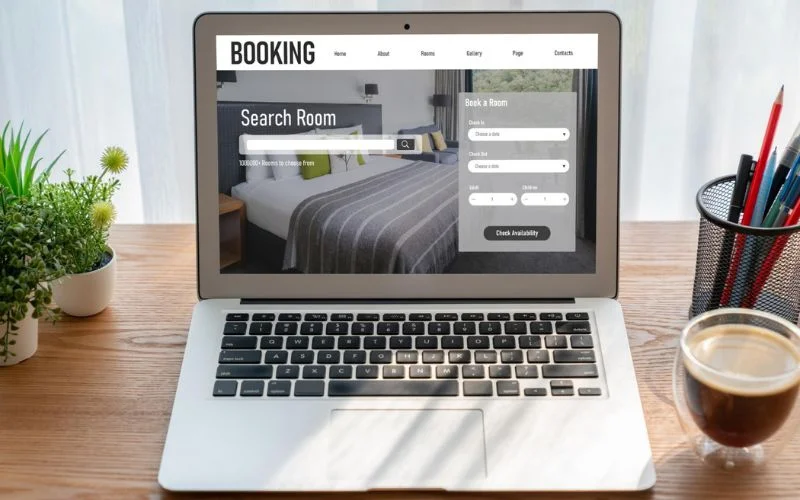
Let’s start with Booking.com. This platform applies a relatively simple commission model, but there are certain nuances you need to understand:
- Base percentage: it is between 14% and 16% of the booking amount for holiday lets in Spain. However, in high-demand cities such as Barcelona or Madrid, it may increase slightly. Not by much, but you do pay a little more.
- Payment processing cost: if you use the “Payments by Booking.com” service, the platform adds around an extra 1.3% for processing.
- VAT on the commission: they apply 21% VAT, or 7% IGIC if you are in the Canary Islands.
- Visibility programmes: if you join Genius or Preferred, you can improve your positioning on Booking.com, but they increase the commission by 2 to 3 percentage points.
So, depending on the case, a property owner can end up paying around 20% on average if they are not careful or simply fail to take these details, or “small” hidden costs, into account.
Airbnb commission

As for Airbnb, it is a slightly different platform that offers two options:
On the one hand, there is the split-fee model:
If you do not work with a holiday let management agency like us, this is most likely the fee model being applied to you, as it is the default setting for most individual hosts.
If this is your case, these would be the conditions:
- Host commission: a 3% Airbnb commission on the booking subtotal.
- Guest fee: the platform adds an Airbnb service fee for the traveller, which can reach 14.2%.
It sounds a little strange, doesn’t it?
A fee model where the guest pays more than the host?
That is how it works, and it is a major advantage because your margin remains high while the final price for the guest increases. Even so, guests accept it thanks to the trust generated by the Airbnb brand…
Although, a little later, we will also see that it has its drawbacks.
On the other hand, there is the host-only fee:
You have probably seen it at some point because Airbnb applies it to accounts labelled as “professional” or to several listings managed centrally.
In fact, it is more typical of holiday let management agencies, although you can also request it if you think showing a “no fees” price in the listing benefits you.
That said, the conditions change compared with the previous model:
- The owner assumes between 14% and 16%, and the guest pays no commission.
- It is mandatory if you work with a channel manager or manage several listings.
What is the advantage?
Basically, the published price is more attractive because no fees are applied to the guest. This greatly improves conversion, meaning the number of times your property is booked.
So, taking this into account, you only need to decide what matters most to you:
- Trying to earn more from each booking, but with a higher risk that guests do not book, which would be option 1.
- Keeping the property booked for most of the year while earning a little less each time, which would be option 2.
Comparison between Booking.com and Airbnb
Now that you have all the information, we suggest analysing two further aspects to understand which platform suits you best and how to use them in your favour:
Who pays the commission:
- On Booking.com, the cost falls entirely on the property owner.
- On Airbnb, you can share the burden, with 3% paid by you and the rest by the traveller, or assume it fully if you choose the host-only fee.
How the guest perceives the price:
- Booking.com shows a closed price with no visible surcharges.
- On Airbnb, with the split-fee model, the visitor sees the full breakdown, while with host-only, they perceive a final amount with no surprises.
Rate flexibility:
- Booking.com requires price consistency across channels.
- Airbnb gives you total freedom to experiment with discounts, offers and weekly rates.
To make it even clearer and summarise it further:
Booking.com provides immediate visibility and steadier bookings, although at the cost of a tighter margin.
Airbnb, on the other hand, allows you to adjust the Airbnb commission model and, with it, adapt your strategy according to the season and type of audience.ar la comisión Airbnb y, con ello, adaptar la estrategia según temporada y tipo de público.
Tips for choosing the best option
As always, it will depend on each case, but the ideal approach is to:
- Calculate your net margin: this is essential. Before publishing, review every cost line and project the real profit per night so there are no surprises when you receive payments.
- Diversify channels: we always recommend listing the property on several OTAs to reduce the risk of empty periods and maximise average annual occupancy.
- Adjust rates strategically: there are no magic formulas, but there are smart ones. For example, offset the Booking.com commission by slightly increasing the price on that platform. On Airbnb, if you work with the split-fee model, keep the base price as competitive as possible, even knowing that the guest will see the commission.
- Analyse whether visibility programmes are worth it: Genius or Preferred can fill empty gaps in low season, but it is best to activate them and measure the results.
- Protect your reputation: this is essential because, on Airbnb, a rating above 4.7 justifies higher prices even with the guest service fee.
Have you decided which platforms you want to be on?
Our recommendation is very clear: be present on both platforms, and on as many as you can. It is the best way to ensure your year is covered and that you achieve maximum profitability.
That said, being on every platform takes time. You need to analyse costs and raise or lower rates depending on the specific time of year, supply and demand.
But do not worry: if you need help managing your property, at Home2Book we are a holiday let management company that manages more than 600 homes, so you can have complete peace of mind leaving your property in good hands.
Write to us through this form and we will be happy to help.